The query contains references to items defined on a different data context.Friday, August 13, 2010
LINQ2SQL Exception: The query contains references to items defined on a different data context
JQuery
- JQuery site:
http://jquery.com/ - JQuery UI building:
http://jqueryui.com/ - 20 Advanced JQuery effects:
http://www.webdesignerdepot.com/2010/07/20-demos-showing-advanced-jquery-effects/ - Setting cookies with JQuery:
http://www.electrictoolbox.com/jquery-cookies/
Wednesday, August 11, 2010
Reset The Primary Key Of A Table
- Insert:
http://msdn.microsoft.com/en-us/library/ms174335.aspx
http://www.google.co.uk/search?sourceid=chrome&ie=UTF-8&q=t-sql+insert - Rollback:
http://msdn.microsoft.com/en-us/library/ms181299.aspx
http://www.google.co.uk/search?hl=en&q=t-sql+rollback&aq=f&aqi=g2g-c2g1&aql=&oq=&gs_rfai= - DBCC CHECKIDENT:
http://msdn.microsoft.com/en-us/library/ms176057.aspx
http://www.google.co.uk/search?sourceid=chrome&ie=UTF-8&q=DBCC+CHECKIDENT - Data type maximum values:
http://www.tsqltutorials.com/datatypes.php
http://www.google.co.uk/search?sourceid=chrome&ie=UTF-8&q=t-sql+int+maximum+value - Pinal Dave:
http://blog.sqlauthority.com/2007/03/15/sql-server-dbcc-reseed-table-identity-value-reset-table-identity/
LINQ: NOT IN / NOT EXISTS
- http://programminglinq.com/blogs/marcorusso/archive/2008/01/14/the-not-in-clause-in-linq-to-sql.aspx
Concept Car Designs
- Interesting gallery of personal designs - http://www.mr-shojaie.com/
- Concept gallery - http://www.carbodydesign.com/gallery/2009/04/30-iran-car-design-exhibition/
- Favourite 1 - http://www.carbodydesign.com/gallery/2009/04/30-iran-car-design-exhibition/14/
- Favourite 2 - http://www.carbodydesign.com/gallery/2009/04/30-iran-car-design-exhibition/16/
Wednesday, July 21, 2010
Elite For The iPhone And iPad
Server Error With Virtual Directory
Server Error in '/TestSubSite' Application.
Configuration Error
Description: An error occurred during the processing of a configuration file required to service this request. Please review the specific error details below and modify your configuration file appropriately.Parser Error Message: Could not load file or assembly 'SControls' or one of its dependencies. The system cannot find the file specified. (D:\web\testsite\web.config line 211)
Source Error:
|
Source File: D:\web\testsite\web.config Line: 211
Thursday, July 15, 2010
How To Get DateTime In XSLT
xmlns:xsl="http://www.w3.org/1999/XSL/Transform"
xmlns:msxsl="urn:schemas-microsoft-com:xslt"
xmlns:my="urn:sample" extension-element-prefixes="msxml">
<msxsl:script language="JScript" implements-prefix="my">
function today()
{
return new Date();
}
</msxsl:script>
<xsl:template match="/">
Today = <xsl:value-of select="my:today()"/>
</xsl:template>
</xsl:stylesheet>
/// Takes a string containing XML to be parsed and a string containing the the XSLT to do the parsing.
/// </summary>
public static string XSLTransformation(string xml, string xsl)
{
// create the readers for the xml and xsl
XmlReader reader = XmlReader.Create(new StringReader(xsl));
XmlReader input = XmlReader.Create(new StringReader(xml));
// create the xsl transformer
XslCompiledTransform t = new XslCompiledTransform(true);
XsltSettings settings = new XsltSettings(false, true);
t.Load(reader, settings, null);
// create the writer which will output the transformed xml
StringBuilder sb = new StringBuilder();
XmlWriterSettings tt = new XmlWriterSettings();
//tt.Encoding = new UTF8Encoding(false);
XmlWriter results = XmlWriter.Create(new StringWriter(sb)); //, tt);
// write the transformed xml out to a stringbuilder
t.Transform(input, null, results);
// return the transformed xml
return sb.ToString();
}
Every Project Fails
Wednesday, July 14, 2010
- How Google works: http://www.ppcblog.com/how-google-works/
- How Google ranks search results: http://www.google.com/technology/pigeonrank.html
Tuesday, July 13, 2010
SQL Knowledge Base
- Getting the last inserted key (identity):
http://blog.sqlauthority.com/2007/03/25/sql-server-identity-vs-scope_identity-vs-ident_current-retrieve-last-inserted-identity-of-record/ - T-SQL FOR XML Basics:
http://blah.winsmarts.com/2007-2-Bak2Basics__Learn_T-SQL_-_FOR_XML.aspx - T-SQL XML Crib-sheet:
http://www.simple-talk.com/sql/learn-sql-server/sql-server-xml-cribsheet/#fourth - Robyn Page's SQL Articles:
http://www.simple-talk.com/author/robyn-page/ - Never do this- Validating a URL in SQL:
http://sqlblog.com/blogs/adam_machanic/archive/2006/07/12/validate-a-url-from-sql-server.aspx - Reading XML files into table fields:
- http://stackoverflow.com/questions/3245301/using-t-sql-to-read-an-xml-feed-directly-into-an-xml-field-in-a-table
- SSIS XML Import tutorial video:
http://msdn.microsoft.com/en-us/library/cc952927(SQL.100).aspx - Processing XSLT in SQL Server:
http://blogs.msdn.com/b/mrorke/archive/2005/06/28/433471.aspx - Numbering Rows:
http://blogs.x2line.com/al/archive/2005/11/18/1323.aspx - Rollbacks:
http://www.geekinterview.com/question_details/33247
http://msdn.microsoft.com/en-us/library/aa175920(SQL.80).aspx
Thursday, July 08, 2010
Parsing XML Into T-SQL Tables
The aim was to make a query which would take any XML and list, in one table, all the elements, their attributes and their element and attribute values of the immediate child nodes of the root node. On top of that, each immediate child of the root had to be enumerated so it could be referenced properly when being inserted into another table/s.
Example input:
<root>
<date>07/07/10</date>
<start>07/02/10</start>
<m code="AL">
<Time>10:22</Time>
<Ask>1943.25</Ask>
<Open>1940.00</Open>
</m>
<m code="AA">
<Time>14:42</Time>
<Ask>143.05</Ask>
<Open>230.50</Open>
</m>
</root>
Example output:
| ElementIndex | ParentElement | FieldName | NodeType | FieldValue |
|---|---|---|---|---|
| 1 | m | Time | element | 10:22 |
| 1 | m | Ask | element | 1943.25 |
| 1 | m | Open | element | 1940.00 |
| 1 | m | code | attribute | AL |
| 2 | m | Time | element | 14:42 |
| 2 | m | Ask | element | 143.05 |
| 2 | m | Open | element | 230.50 |
| 2 | m | code | attribute | AA |
And finally, the SQL...
declare @xml XML
set @xml = 'YOUR XML HERE'
create table #t
(
rownum int,
xmlextract xml
)
-- populate the table with the child nodes of the root, if they have their own sub nodes
insert into #t
SELECT
row_number() over(order by getdate()) as 'RowNum',
pref.query('.') as XmlExtract
FROM
@xml.nodes('/*/*') AS extract(pref)
WHERE
pref.value('./*[1]', 'nvarchar(50)') IS NOT NULL
SELECT distinct rownum 'ElementIndex', ParentName 'ParentElement', FieldName, NodeType, FieldValue FROM
(
-- selects the attributes and their values from the xml
SELECT DISTINCT
rownum,
SubEl.SubElem.value('local-name(..)', 'nvarchar(50)') AS ParentName,
SubEl.SubElem.value('local-name(.)', 'nvarchar(50)') AS FieldName,
'attribute' as NodeType,
SubEl.SubElem.value('.', 'nvarchar(150)') AS FieldValue
FROM
#t
CROSS APPLY
xmlextract.nodes('//@*') AS SubEl(SubElem)
UNION
-- selects the inner element and their values from the xml
SELECT
rownum,
SubEl.SubElem.value('local-name(..)', 'nvarchar(50)') AS ParentName,
SubEl.SubElem.value('local-name(.)', 'nvarchar(50)') AS FieldName,
'element' as NodeType,
SubEl.SubElem.value('.', 'nvarchar(150)') AS FieldValue
FROM
#t
CROSS APPLY
xmlextract.nodes('/*/*') AS SubEl(SubElem)
) as tmp
ORDER BY ElementIndex, ParentElement, FieldName
drop table #t
However, for performance and tidy-up reasons, when using this code in a stored procedure, you may want to use a table variable. Here's the modified version:
declare @xml XML
set @xml = 'YOUR XML HERE'
declare @t table
(
rownum int,
xmlextract xml
)
-- populate the table with the child nodes of the root, if they have their own sub nodes
insert into @t
SELECT
row_number() over(order by getdate()) as 'RowNum',
pref.query('.') as XmlExtract
FROM
@xml.nodes('/*/*') AS extract(pref)
WHERE
pref.value('./*[1]', 'nvarchar(50)') IS NOT NULL
SELECT distinct rownum 'ElementIndex', ParentName 'ParentElement', FieldName, NodeType, FieldValue FROM
(
-- selects the attributes and their values from the xml
SELECT DISTINCT
rownum,
SubEl.SubElem.value('local-name(..)', 'nvarchar(50)') AS ParentName,
SubEl.SubElem.value('local-name(.)', 'nvarchar(50)') AS FieldName,
'attribute' as NodeType,
SubEl.SubElem.value('.', 'nvarchar(150)') AS FieldValue
FROM
@t
CROSS APPLY
xmlextract.nodes('//@*') AS SubEl(SubElem)
UNION
-- selects the inner element and their values from the xml
SELECT
rownum,
SubEl.SubElem.value('local-name(..)', 'nvarchar(50)') AS ParentName,
SubEl.SubElem.value('local-name(.)', 'nvarchar(50)') AS FieldName,
'element' as NodeType,
SubEl.SubElem.value('.', 'nvarchar(150)') AS FieldValue
FROM
@t
CROSS APPLY
xmlextract.nodes('/*/*') AS SubEl(SubElem)
) as tmp
ORDER BY ElementIndex, ParentElement, FieldName
References:
Tuesday, July 06, 2010
SQLXML Gymnastics
SELECTID,Name as 'Names/FirstName',Surname as 'Names/LastName'FROMNamesFOR XML PATH('person'), ROOT('people')
<Elements><Element><Index>1</Index><Type>3M</Type><Code>AL</Code><Time>1900-01-01T10:22:00</Time></Element><Element><Index>2</Index><Type>3M</Type><Code>AA</Code><Time>1900-01-01T19:00:00</Time></Element></Elements>
SELECTr.value('Index[1]', 'int') [Index],r.value('Type[1]', 'nvarchar(50)') [Type],
r.value('Code[1]', 'nvarchar(50)') [Code],
r.value('Time[1]', 'datetime') [Time]FROM@content.nodes('/Elements/*') AS records(r)
<Elements><Element><Index>1</Index><Type>3M</Type><Code>AL</Code><Time>1900-01-01T10:22:00</Time></Element><Element><Index>2</Index><Type>3M</Type><Code>AA</Code><Time>1900-01-01T19:00:00</Time></Element></Elements>
SELECTEl.Elem.value('(Index)[1]', 'int') [Index],SubEl.SubElem.value('local-name(.)', 'varchar(100)') AS 'Field Name',SubEl.SubElem.value('.', 'varchar(100)') AS 'Field Value'FROM@content.nodes('/Elements/Element') AS El(elem)CROSS APPLYEl.Elem.nodes('*') AS SubEl(SubElem)WHERESubEl.SubElem.value('local-name(.)', 'varchar(100)') <> 'Index'
| Index | Field Name | Field Value |
| 1 | Type | 3M |
| 1 | Code | AL |
| 1 | Time | 1900-01-01T10:22:00 |
| 2 | Type | 3M |
| 2 | Code | AA |
| 2 | Time | 1900-01-01T19:00:00 |
SELECTelem.value('local-name(..)', 'nvarchar(10)') AS 'Parent Name',elem.value('local-name(.)', 'nvarchar(10)') AS 'Attribute Name',elem.value('.', 'nvarchar(10)') AS 'Attribute Value'FROM@content.nodes('//@*') AS El(elem)
SELECT DISTINCT r.value('fn:local-name(.)', 'nvarchar(50)') FieldNameFROM @xml.nodes('/*/*') AS records(r)
SELECTpref.query('.') as SomeXml,FROM@xml.nodes('/*/*') AS Content(pref)
SELECTrow_number() over(order by cast(pref.query('.') as nvarchar(max))) as 'RowNum',pref.query('.') as XmlExtractFROM@xml.nodes('/*/*') AS extract(pref)WHEREpref.value('./*[1]', 'nvarchar(10)') IS NOT NULL
DECLARE @content XMLSET @content ='<people><person id="1" bimble="1"><firstname bobble="gomble">John</firstname><surname>Doe</surname></person><person id="2" bimble="11"><firstname bobble="zoom">Mary</firstname><surname>Jane</surname></person><person id="4" bimble="10"><firstname bobble="womble">Matt</firstname><surname>Spanner</surname></person></people>'
-- All attributes with parent element nameSELECTelem.value('local-name(..)', 'nvarchar(10)') AS 'Parent Name',elem.value('local-name(.)', 'nvarchar(10)') AS 'Attribute Name',elem.value('.', 'nvarchar(10)') AS 'Attribute Value'FROM@content.nodes('//@*') AS El(elem)-- Inner element values (with index attribute)SELECTEl.Elem.value('(@*)[1]', 'int') [Index],SubEl.SubElem.value('local-name(.)', 'nvarchar(10)') AS 'Field Name',SubEl.SubElem.value('.', 'nvarchar(10)') AS 'Field Value'FROM@content.nodes('/*/*') AS El(elem)CROSS APPLYEl.Elem.nodes('*') AS SubEl(SubElem)-- Second level element attributes (with index attribute)SELECTEl.Elem.value('(@*)[1]', 'int') [Index],SubEl.SubElem.value('local-name(.)', 'nvarchar(10)') AS 'Field Name',SubEl.SubElem.value('.', 'nvarchar(10)') AS 'Field Value'FROM@content.nodes('/*/*') AS El(elem)CROSS APPLYEl.Elem.nodes('@*') AS SubEl(SubElem)-- Third level element attributes (with index attribute)SELECTEl.Elem.value('(@*)[1]', 'int') [Index],SubEl.SubElem.value('local-name(.)', 'nvarchar(10)') AS 'Field Name',SubEl.SubElem.value('.', 'nvarchar(10)') AS 'Field Value'FROM@content.nodes('/*/*') AS El(elem)CROSS APPLYEl.Elem.nodes('*/@*') AS SubEl(SubElem)-- All element attributes and parent element name (with index attribute)SELECT DISTINCTEl.Elem.value('(@*)[1]', 'int') [Index],SubEl.SubElem.value('local-name(..)', 'nvarchar(10)') AS 'Parent Name',SubEl.SubElem.value('local-name(.)', 'nvarchar(10)') AS 'Field Name',SubEl.SubElem.value('.', 'nvarchar(10)') AS 'Field Value'FROM@content.nodes('/*/*') AS El(elem)CROSS APPLYEl.Elem.nodes('//@*') AS SubEl(SubElem)ORDER BY [Index]
- http://beyondrelational.com/blogs/jacob/archive/2010/05/30/select-from-xml.aspx
- http://stackoverflow.com/questions/3180834/retrieving-xml-element-name-using-t-sql/3180868#3180868
- http://stackoverflow.com/questions/2266132/how-can-i-get-a-list-of-element-names-from-an-xml-value-in-sql-server
- http://www.stylusstudio.com/sqlxml_tutorial.html
- http://blogs.msdn.com/b/simonince/archive/2009/04/24/flattening-xml-data-in-sql-server.aspx
- http://centricle.com/tools/html-entities/
Monday, July 05, 2010
Some Tech Stuff I Really Must Read
- http://www.dotnetcurry.com/ShowArticle.aspx?ID=515&AspxAutoDetectCookieSupport=1
- http://www.highoncoding.com/Articles/697_Persisting_CheckBox_State_While_Paging_in_GridView_Control.aspx
- http://csharpbits.notaclue.net/2010/06/securing-dynamic-data-4-replay.html
- http://dotnetslackers.com/articles/aspnet/ASP-NET-MVC-2-0-Areas.aspx
- http://www.c-sharpcorner.com/UploadFile/vendettamit/733/Default.aspx
- http://geekswithblogs.net/WinAZ/archive/2010/04/07/using-linq-distinct-with-an-example-on-asp.net-mvc-selectlistitem.aspx
Friday, July 02, 2010
Server Application Unavailable
Adding And Subtracting Dates In T-SQL
@declare myDate datetimeset @myDate = (select dateadd(dd,10,getdate()))select @myDate
@declare myDate datetimeset @myDate = (select dateadd(mm,-1,@dateArg))select @myDate
Thursday, July 01, 2010
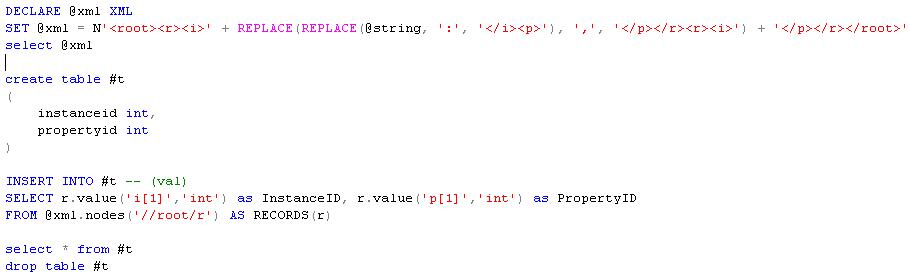
Splitting Strings in T-SQL Using XML
Event Firing Delegate Handlers For Basic Use Controls
public delegate void ChartSelected(int chartId);public ChartSelected onChartSelected = null;
selector.onChartSelected = MyEventMethod;
private void ChartSelected(int chartId){// do something}
if (onChartSelected != null)onChartSelected(someSelectedValue);
Monday, June 28, 2010
More SQL XML, Making It Easier...
- Microsoft.Data.SqlXml.SqlXmlCommand:
http://www.microsoft.com/downloads/details.aspx?familyid=51d4a154-8e23-47d2-a033-764259cfb53b&displaylang=en
- It does throw a large number of exceptions, so your code needs to be clean.
- You will need to remove System.Data.SqlClient because the new DLL replaces the namespaces found in the original DLL.
using Microsoft.Data.SqlXml;string connectionString = ConfigurationManager.ConnectionStrings["connStr"].ConnectionString;SqlXmlCommand queryCommand = new SqlXmlCommand(connectionString);queryCommand.CommandText = @"SQL * FROM something FOR XML";SqlXmlParameter queryParameter = queryCommand.CreateParameter();queryParameter.Value = 2860;queryCommand.RootTag = "root";queryCommand.XslPath = Server.MapPath("~/XSLT/formatter.xslt");queryCommand.ClientSideXml = true;XmlDocument xmlChartData = new XmlDocument();xmlChartData.Load(queryCommand.ExecuteXmlReader());
Friday, June 25, 2010
Listing Table Column Names On One Line
select STUFF((SELECT char(9) + name FROM(SELECT c.nameFROM syscolumns c inner join sysobjects o on c.id = o.idwhere o.name = 'your-table-name') AS Y--ORDER BY names -- optional sorting of the column namesFOR XML PATH('')),1, 1, N'')
Wednesday, June 23, 2010
Developing For iPhone
- http://www.saurik.com/id/5
- http://phonegap.pbworks.com/
- http://building-iphone-apps.labs.oreilly.com/ch07.html
Monday, June 21, 2010
Prince Of Persia For iPhone And iPad Is Awesomely 8 Bit

Sunday, June 20, 2010
L2B 2010 - It's Over!
Pictures from the day...
Here's the route we eventually took...
View L2B 2010 in a larger map
London To Brighton 2010
This Father’s Day, Sunday 20th June, I am doing (again) the BHF London to Brighton 58 mile bike ride in a Morph Suit! It’s a grueling challenge filled with blood, sweat, tears, burgers, beer, steep hills and numb-bum-syndrome.
It really is a worthy cause – and I will look a complete prat - so please, if you can, follow this link and donate just a little towards my target for the British Heart Foundation…
http://original.justgiving.com/matthewwebster
Click here to see the estimated route!
View L2B2010 in a larger map
Footnote: Yes, numb-bum-syndrome is real: http://nutritionfitnesslife.com/numb-bum-syndrome/
Friday, June 18, 2010
Calculate XML Element Depth
select="count(ancestor::*)"
- http://www.dpawson.co.uk/xsl/sect2/N2193.html
- int depth = element.Ancestors().Count();
Thursday, June 17, 2010
Direct SQLXML Access And XSLt Using ADO.NET
- ADO.NET access to the SQL:
http://www.sharpdeveloper.net/content/archive/2007/06/09/how-to-use-sqldatareader-plus-source-code.aspx - XSL Transformation:
http://msdn.microsoft.com/en-us/library/ms345117(SQL.90).aspx - Filling DataSets:
http://msdn.microsoft.com/en-us/library/bh8kx08z.aspx - The 'using' statement used appropriately with SqlConnection and SqlCommand:
http://davidhayden.com/blog/dave/archive/2005/01/13/773.aspx
Wednesday, June 16, 2010
Performing Queries With T-SQL DBs With Illegal Characters In Their Name
- Add the SQL Server to the local (on my development machine) SQL Server linked servers list.
This is done by:
Using the Object Explorer and opening "Server Objects -> Linked Servers", right clicking and selecting "New Linked Server".
The important next step is that the "Linked server" field is filled out with the SQL Server name only, eg: SOMELIVEBOX-SQL5 and then the "SQL Server" radio button is selected.
Next, on the left, select "Security" and choose "Be made using this security context:" and fill out the SQL Server login details. - Then the query, and this is only relevant if the SQL Server name has an illegal character (like '-') in it.
Lets say the table is called "MyTable", is in a database called "MyDB", is in the server mentioned in point 1 and we want all the records from it...
Open a new query window from inside the local database and type:
SELECT * FROM [SOMELIVEBOX-SQL5].MyDB.dbo.MyTable
Tuesday, June 15, 2010
My Favourite Chrome Extensions
- Speed Dial
https://chrome.google.com/extensions/detail/dgpdioedihjhncjafcpgbbjdpbbkikmi?hl=en-gb
https://chrome.google.com/webstore/detail/speed-dial-3web/lceefillmbhhileboicaeakgcikdocmm?hl=en-US - InstaPaper
https://chrome.google.com/extensions/detail/acgdjjilmhiofacmdnmmlndeokamkkcl?hl=en-gb - Tube Service Status Updates
https://chrome.google.com/extensions/detail/dcbnpmjhmjhpaegikhpjlaemjiilnkgb?hl=en-gb - CoolIris
https://chrome.google.com/extensions/detail/noocneohefmdhonidldnlhaainpiomkp?hl=en-gb - Fastest Chrome
https://chrome.google.com/extensions/detail/mmffncokckfccddfenhkhnllmlobdahm?hl=en-gb - Downloads
https://chrome.google.com/extensions/detail/jfchnphgogjhineanplmfkofljiagjfb?hl=en-gb - Quick QR
https://chrome.google.com/extensions/detail/bcfddoencoiedfjgepnlhcpfikgaogdg?hl=en-gb - GMail Checker Plus
https://chrome.google.com/extensions/detail/gffjhibehnempbkeheiccaincokdjbfe?hl=en-gb - Join Tabs
https://chrome.google.com/webstore/detail/binjiceocgbfooocmheaenmmcominbpe - XMarks Bookmark Sync
https://chrome.google.com/webstore/detail/ajpgkpeckebdhofmmjfgcjjiiejpodla - Page Snooze
https://chrome.google.com/webstore/detail/bmhnhpfchoeofnjoobbhgihdkhllnfbc - Print Friendly
https://chrome.google.com/webstore/detail/jmplllfmgpkogegnjnkecmkdbeaeheop - youR Here
https://chrome.google.com/webstore/detail/fkandkgadbpobooanbmiiinlelnhbabm - Edit This Cookie
https://chrome.google.com/webstore/detail/edit-this-cookie/fngmhnnpilhplaeedifhccceomclgfbg
Thursday, June 10, 2010
Can't Connect To Local SQLEXPRESS
I encountered the exact same error. My work around to get the server back up and running is as follows. This applies to both the engine and the agent. The bug in this patch didn't affect the other SQL related services.
I changed the service account from the normal one to one that is local administrator to the server (me).
I was then able to start the services.
I went into the SQL Server 2005 Surface Area Configuration tool and changed Database Engine -> Remote Connections to use Local connections only.
I restarted the engine service.
I then changed it back to using Local and remote connections Using TCP/IP only.
I restarted the engine service.
I then changed both services back to their normal service account and all is well.
I could not get the patch to apply under any circumstances or configuration that I tried and have given up on it in hopes that MS releases a new one for this real quick.
Tuesday, June 08, 2010
Google Proxy Setting
- Target: "C:\Documents and Settings\
\Local Settings\Application Data\Google\Chrome\Application\chrome.exe" --proxy-server=
Sunday, June 06, 2010
Load Balanced Session State Partitioning
- http://code.msdn.microsoft.com/velocity/
http://en.wikipedia.org/wiki/Velocity_(memory_cache)
http://www.microsoft.com/downloads/details.aspx?FamilyId=B24C3708-EEFF-4055-A867-19B5851E7CD2&displaylang=en - http://memcached.org/
- http://www.alachisoft.com/ncache/index.html
- http://www.scaleoutsoftware.com/products/state_server.php
- http://sharedcache.codeplex.com/
http://www.sharedcache.com/
- http://blog.maartenballiauw.be/post/2007/11/ASPNET-load-balancing-and-ASPNET-state-server-(aspnet_state).aspx
- http://blog.maartenballiauw.be/post/2008/01/ASPNET-Session-State-Partitioning.aspx
- http://blog.maartenballiauw.be/post/2008/01/24/ASPNET-Session-State-Partitioning-using-State-Server-Load-Balancing.aspx
- http://en.aspnet-bhs.info/post/State-Server-Partitioning.aspx
- http://www.theserverside.net/news/thread.tss?thread_id=47330
- http://www.codeproject.com/KB/session/ASPNETSession.aspx
- http://blogs.msdn.com/velocity/archive/2008/06/05/how-to-use-session-store-provider-microsoft-project-code-named-velocity.aspx
- http://stackoverflow.com/questions/2063421/scaleout-vs-ncache
- http://forums.asp.net/t/1030680.aspx
- http://forums.asp.net/t/1210004.aspx
- http://stackoverflow.com/questions/489270/caching-and-session-state-management-using-microsoft-velocity-and-memcached
- http://stackoverflow.com/questions/856959/which-distributed-cache
- http://predicatet.blogspot.com/2009/09/download-microsoft-web-application.html
- http://support.microsoft.com/kb/231282
- http://www.west-wind.com/presentations/webstress/webstress.htm
- http://ask-leo.com/can_i_monitor_or_control_the_bandwidth_used_on_my_home_network.html
- http://www.softwareqatest.com/qatweb1.html#LOAD
- What a 'Cache' is: http://en.wikipedia.org/wiki/Cache
- "Caching in the distributed environment": http://msdn.microsoft.com/en-us/library/dd129907.aspx
- Memcached Vs Velocity Showdown: http://www.briandrought.com/blog/?p=29
- Distributed
- Partitioaned
- Replicated
- Remote clients available
- Expensive
- Failover
- Clustered
- Free developer edition not appropriate for live environments
- Free
- Open source
- Distributed
- Not partitioned
- Not replicated
- Servers unaware of each other
- Not clustered
- Least recently used model
- Sparsely documented
Friday, June 04, 2010
Rediscovering A Blog Entry On The Button Element
Thursday, June 03, 2010
Get Notified About Public Holidays
T-SQL IsNullOrEmpty
Wednesday, June 02, 2010
How To List The Columns In Your Table
select c.* from sysobjects o inner join syscolumns c on o.id = c.idwhere o.xtype = 'U' and o.name = 'myTableName'
Friday, May 28, 2010
Concatenating String Fields In T-SQL
Thursday, May 27, 2010
PIVOT
Friday, May 21, 2010
Virtual Machines
- http://en.wikipedia.org/wiki/Virtual_machine#List_of_virtual_machine_software
- http://en.wikipedia.org/wiki/Comparison_of_platform_virtual_machines
- VirtualBox
http://www.virtualbox.org/wiki/VirtualBox
http://en.wikipedia.org/wiki/VirtualBox - Hyper-V
http://www.microsoft.com/hyper-v-server/en/us/default.aspx
http://en.wikipedia.org/wiki/Hyper-V - VirtualPC
http://www.microsoft.com/windows/virtual-pc/default.aspx
http://en.wikipedia.org/wiki/VirtualPC - BootCamp
http://www.apple.com/macosx/compatibility/
http://en.wikipedia.org/wiki/Boot_Camp_(software) - Parallels
http://www.parallels.com/uk/products/desktop/
http://en.wikipedia.org/wiki/Parallels_Desktop_for_Mac - Parallels Workstation
http://www.parallels.com/uk/products/desktop/pd4wl/
http://en.wikipedia.org/wiki/Parallels_Workstation - VMWare
http://www.vmware.com/
http://en.wikipedia.org/wiki/VMware
- VirtualPC - Quite good, does what it says on the tin but hogs a lot of system resources. Will run non-Windows OS's, but probably is better running Windows. Discontinued, I understand, in deference to Hyper-V.
- Parallels - Not the same kind of virtual machine as VirtualPC, in that it's expressly designed to run Windows on a Mac, but it does this beautifully. It can startup Windows which has been installed into Parallels or BootCamp and run them side by side.
- BootCamp - Runs Windows on a Mac as a stand-alone OS, in that Mac OS X is not running at the same time. Allows the Mac to operate as a Windows PC and does it pretty much better than a regular PC can IMHO.
- VMWare - Basically just like VirtualPC, but many would have it as being more stable and not Microsoft.


